Scientific article · Sources checked 2026-10-21 · Updated 2026-10-21
Facial Melasma Trials: Reading Clinical Severity Alongside Skin Reactions
How facial diagnosis, severity categories, missing observations and participant-level safety counts shape the interpretation of a triple-combination cream trial.
Editorial reading of public sources. No clinician sign-off, personal product test, skin assessment or examination of a supplied preparation is claimed.
A face-cream comparison becomes clinically meaningful only when the condition, the assessment and the preparation line up. A photograph of a darker patch is not itself a diagnosis, and a reduction in a severity score is not a chemical measurement of pigment removed. Reading a melasma trial therefore starts with the clinical question that researchers actually investigated, before its results become shorthand for a broad class of products.
This analysis examines how an investigator’s rating becomes a treatment-response statistic, and how that statistic should be read alongside skin reactions. The aim is to understand the evidence at the level of the face being assessed and the formulation being tested. Our guide to assessing a facial dark spot supplies a useful starting question: what condition would a proposed comparison need to address?
Inside this record
Study facts at a glance
Clinical applicability: Diagnosis and assessment site belong in the comparison before a product percentage. Source 1 Source 2
Severity arithmetic: A category change and a final skin state answer different questions. Source 1 Source 2
Counting safety: Affected participants and accumulated episodes require different denominators. Source 1
Formulation identity: A shared ingredient name does not establish a shared clinical result. Source 1 Source 2
Practical uncertainty: An unmeasured outcome needs further evidence, not a favorable assumption. Source 1 Source 2 Source 3
The face is an assessment site, not a diagnosis
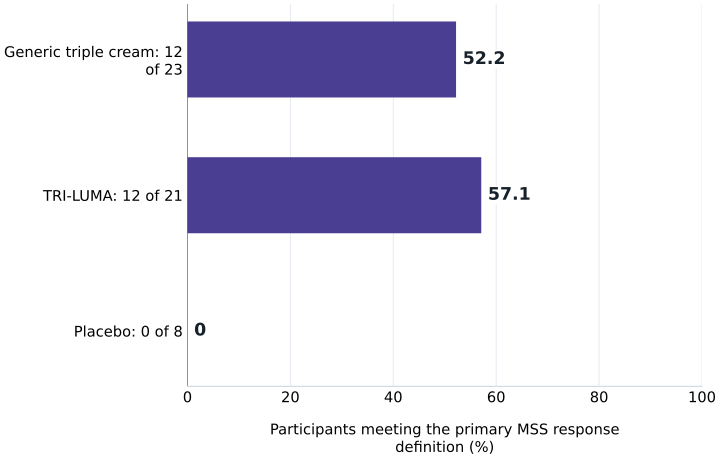
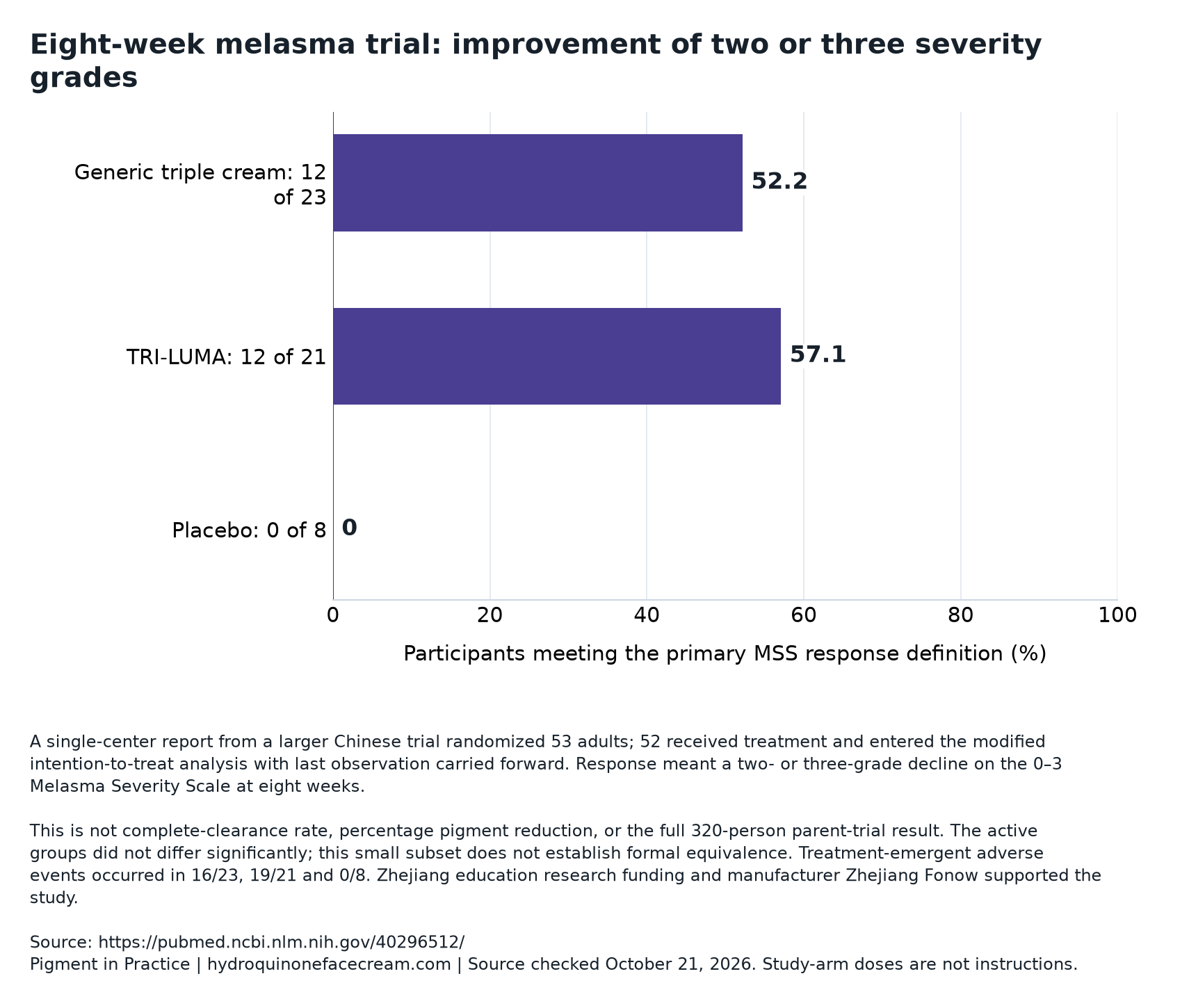
The Chinese single-center report randomized 53 adults, ages 33–55, mostly women with epidermal melasma; its 320-person parent trial was not analyzed here. This defines the population behind the observations. A reader looking at a cheek, forehead or another facial area still needs to distinguish anatomical resemblance from diagnostic resemblance. Two concerns can occur on the same part of the face without becoming the same research question. The scientific bridge is the assessed condition and its severity, rather than the location alone. That distinction matters before any product-level comparison begins.
The US Tri-Luma label concerns short-term, moderate-to-severe facial melasma with sun avoidance and sunscreen; other hyperpigmentation conditions and Fitzpatrick types V–VI were not studied. These boundaries do not supply a result for people outside them. They identify where an additional evidence bridge would be necessary. It is also unsound to use a geographic population label as a substitute for a recorded skin phototype. Applicability is a sequence of specific comparisons: diagnosis, assessment method, population, preparation and setting. None can be filled in simply because the reader recognizes the word hydroquinone.
Read the underlying chart data: download CSV or download the source-labeled chart.
A change in grade does not specify the finishing point
The Melasma Severity Scale (MSS) orders clinician ratings from zero to three. Think about the arithmetic of ordered categories: subtracting two from three leaves one, whereas subtracting two from two leaves zero. This is an illustration of the scoring rule, not a reconstruction of any participant’s trajectory. The same size change can therefore lead to different final states. A response definition based on movement along the scale groups those trajectories together, while a definition based on reaching the bottom category separates them. The table preserves that distinction instead of placing every percentage under an undifferentiated success heading.
Nor should a grade be read as a unit of pigment concentration. The categories put observations in an order; they do not establish equal biological distances between neighboring ratings. Moving across two categories cannot be translated into a proportion of melanin removed. A response threshold is useful because it makes the classification explicit and reproducible enough to compare groups. Its usefulness does not turn it into a continuous laboratory measurement. When comparing facial treatments, retain both parts of the definition: what was observed and the rule that converted the observation into a counted response.
Eight-week endpoints: Chinese response, MSS decrease ≥2 grades; US-label clearance, MSS zero.
| Study / arm | Endpoint | Participants, n/N (%) |
|---|---|---|
| generic | Response | 12/23 (52.2%) |
| Tri-Luma | Response | 12/21 (57.1%) |
| placebo | Response | 0/8 (0%) |
| US label, trial 1: Tri-Luma | Clearance | 32/85 (38%) |
| US label, trial 2: Tri-Luma | Clearance | 10/76 (13%) |
Missing visits change what the final number represents
The Chinese analysis included 52 treated participants; 44 completed. Missing outcomes used last observation carried forward. This method fills an unavailable later assessment with an earlier recorded assessment rather than deleting the person entirely. The resulting estimate is therefore not simply a photograph of everyone who attended the final visit. It combines observed information with an explicit rule about unavailable information. That rule can preserve more of the assigned group, but its apparent completeness should not be confused with complete observation. A filled data cell and a directly measured final result have different evidentiary histories.
Consider the direction of uncertainty without inventing missing results. If someone’s condition would have improved after their last recorded visit, carrying the earlier value forward misses that improvement. If it would have worsened, the same procedure misses worsening. Both possibilities explain why the method is not inherently conservative in every setting. The relevant questions are whether missingness relates to response, tolerance or circumstances outside treatment, and whether another reasonable analysis changes the conclusion. An estimate should be described with its actual analysis population; a larger recruitment total cannot supply the observations that are absent.
The preparation and the background routine belong in the experiment
The blinded trial’s active creams contained hydroquinone 4%, tretinoin 0.05% and fluocinolone acetonide 0.01%; everyone received cleanser, moisturizer and sunscreen. These details identify what was compared, not an application recipe. From a design perspective, a shared background routine helps make the treatment assignment the principal planned difference. It also means that the result describes a preparation used within that background. Removing the common care from the description would change the experiment readers imagine. The guide to hydroquinone percentages approaches the same documentary problem: a concentration needs its full product context.
The label’s two trials instead compared the triple cream with three dual-active combinations in the same vehicle. A comparator determines which counterfactual question a study can address. Removing one active component asks something different from comparing with a placebo preparation. Likewise, neither design automatically isolates how a distinct cream base, added ingredient or service arrangement would perform. Our Dermatica formula review can be used to inspect documentary terms, without treating that review as evidence that a listed preparation reproduces a trial result. Matching a formula on paper is an identification step, not a completed clinical comparison.
Similar group estimates leave a question about precision
The primary active-arm difference was nonsignificant; formal equivalence was not established. These statements concern different statistical tasks. A superiority analysis asks whether the observed contrast provides sufficient evidence against no difference. An equivalence analysis asks whether plausible differences are confined within a justified range small enough to be considered unimportant. Failing the first task does not accomplish the second. A broad interval can include both no difference and differences that would matter. Reporting only a significance label removes the information needed to distinguish a precise comparison from an inconclusive one.
This distinction is especially useful when reading a small facial-treatment study with several clinical assessments. Agreement in the direction of findings can make a result coherent without making every comparison precise. The relevant uncertainty belongs to the between-group contrast, not just to each group considered separately. A future equivalence claim would need its margin, rationale, analysis and interval to be visible together. It would also need to explain how missing observations were handled. The scientific conclusion should describe the comparison supported by those elements; the word generic alone is not an equivalence analysis or a finding about US availability.
A safety percentage counts people under a particular rule
Overall treatment-emergent event rates did not differ significantly; irritation did (P<.05). The distinction matters because a total category and one component category are different outcomes. A person can contribute to several specific reaction categories while contributing only once to the any-event category. Adding the component counts would therefore answer the wrong question unless the analysis explicitly intended to count episodes rather than affected participants. The table is a participant-level summary, not an inventory of every sensation or repeated occurrence.
There is another distinction between timing and attribution. An event recorded after treatment begins is not, by that timing alone, proven to have been caused by the preparation. Conversely, requiring an investigator to judge relatedness introduces a narrower classification rule. The label separately reports treatment-related events; those percentages should not be used as if they were measured with an interchangeable counting rule. A useful safety comparison asks about the event definition, observation period, severity assessment, attribution and missing information together. Otherwise, an apparent numerical advantage can be created merely by placing unlike categories beside each other.
Chinese study, eight weeks: participants with adverse events; categories overlap.
| Arm | Any event, n/N (%) | Irritation, n/N (%) |
|---|---|---|
| Generic | 16/23 (69.6%) | 12/23 (52.2%) |
| Tri-Luma | 19/21 (90.5%) | 17/21 (81.0%) |
| Placebo | 0/8 (0%) | 0/8 (0%) |
Frequency, intensity and disruption need separate descriptions
One Tri-Luma participant withdrew because of exfoliation. A withdrawal is informative because it describes a consequence for continued participation, but it is not a complete measure of discomfort. Frequency asks how many people experienced something; intensity asks how severe it was; disruption asks what it changed about participation or daily life. These dimensions cannot be recovered from one another. A frequent mild reaction and an uncommon severe reaction can produce very different judgments even when a single summary percentage makes one appear smaller. The choice of outcome determines which part of the experience becomes visible.
Tri-Luma’s label warns about irritation, sulfite hypersensitivity including anaphylaxis or severe asthma, blue-black ochronosis, and systemic corticosteroid effects including adrenal suppression. Pregnancy and nursing require clinician discussion. These warnings broaden the safety questions beyond a short trial’s table. They do not supply a numerical probability for every individual or prove that every listed reaction occurred in this particular comparison. The follow-up documentation guide helps identify what a care description would need to explain about assessment and communication. A sensible scientific appraisal keeps common observed reactions, serious potential reactions and unanswered monitoring questions visible as separate categories.
A facial improvement assessment does not answer the maintenance question
Tri-Luma is not indicated for maintenance, and the label says melasma usually returns after discontinuation. There are several distinct research questions hidden inside the phrase lasting result: how a condition changes during exposure, whether that change persists after exposure ends, and what happens under a subsequent management strategy. Each needs a defined starting point and observation period. A treatment-phase comparison cannot be extended along the calendar by interpretation alone. Likewise, a result observed during continued treatment cannot be silently relabeled a result after withdrawal. The event that begins follow-up is part of the outcome definition.
For a durable-control study, the protocol would need to specify what counts as recurrence and which participants enter that analysis. Counting only those who first reach a response threshold creates a different population from the original randomized group. Subsequent care could also differ, changing the question from persistence of an initial effect to performance of an ongoing strategy. These are methodological requirements rather than instructions for a personal regimen. They explain why a product review should not convert a treatment-phase percentage into a promise about later months. The comparison of face-cream routes can help keep care arrangements distinct from measured clinical outcomes.
Color measurement offers another view of the assessed face
A separate randomized sunscreen study compared tinted and untinted preparations for five months in 42 women. Its primary measurements were colorimetric; the secondary clinical mMASI comparison showed no significant between-group difference. NAOS funded it, and author industry relationships were disclosed. That study provides a useful methodological contrast because an instrument can measure differences between an affected region and adjacent skin without assigning the same kind of clinical response category. The analysis of the tinted-sunscreen study examines those measurements in detail. It is a separate experiment, not a follow-up arm of the cream trial.
Different measurement tools can be informative without being interchangeable. An instrument may detect a change in local color contrast, while a clinical scale summarizes a broader visual assessment. Agreement can strengthen coherence; disagreement invites examination of what each method measures, its variability and its sampling locations. It does not automatically identify one method as wrong. Nor can a clinically nonsignificant contrast be rewritten as proof that every instrument reading was unchanged. For facial evidence, the useful synthesis is to name the measured property each time. A color-distance result, a severity grade and a clearance classification should retain their own units and definitions.
Product identity and documented support complete the reading
Zhejiang education funding and Fonow supported the Chinese trial; Fonow supplied products. Authors declared no conflicts. These disclosures belong beside the methodological interpretation because readers should know how the work was supported. They neither invalidate a result automatically nor remove the need to inspect it. The same standard applies to an independently funded study: the allocation, endpoints, handling of missing observations and interpretation must withstand examination. Disclosure provides context for scrutiny rather than a numerical adjustment to an effect estimate. It should not be replaced by guessing a company’s role from an author affiliation.
FDA states that no over-the-counter skin-lightening products are approved or legally marketed, and describes reports of rash, facial swelling and potentially permanent ochronosis. This is a distinct regulatory and safety notice, not a verdict on every named compound or cosmetic. Our compounding-status guide and Obagi prescription-record review invite inspection of the relevant documentation. Neither substitutes for matching a product to its own evidence. The final practical question is therefore precise: which preparation, diagnosis, assessment and period does this claim describe, and which of those details remains unverified?
Questions about the evidence
Why does the starting severity matter when the endpoint is a change?
Change requires two observations: a starting state and an ending state. People beginning in different categories can move the same distance and finish in different categories. To interpret an outcome fully, look for both the movement rule and the final-state definition rather than assuming that a counted response describes one uniform appearance.
Can a percentage be meaningful if some final visits are missing?
Yes, but its meaning depends on the analysis. Ask whether the denominator includes only observed visits or also outcomes assigned by a missing-data rule. Then consider what assumptions make that rule reasonable. Precision in reporting means identifying how the number was constructed, rather than treating every calculated value as a directly observed endpoint.
Does a lower irritation count settle the overall safety comparison?
No single category can settle all relevant safety questions. A comparison also needs to address other reactions, their severity, the time observed and consequences such as disruption. A specific finding can be useful within its definition without becoming a general judgment that one preparation is safer in every respect.
What would make a product-review link relevant to this trial?
Its role is documentary: it can help a reader locate the exact product description and questions about the proposed service. Establishing clinical comparability would require a separate match to the investigated preparation and research design. An internal link provides navigation, not an endorsement, an equivalence finding or a guarantee of a result.
How should clinicians’ ratings and instrument measurements be read together?
Start by naming the property each measures and the unit in which it is expressed. Then ask whether the study tested a relationship between them. Apparent consistency can support an interpretation, but converting one measurement into another requires evidence. Keeping both definitions visible is more informative than forcing them into a single success rate.
What this evidence supports
Our interpretation is that facial melasma evidence becomes more useful when each result retains its clinical definition. The assessment site establishes where the observation was made; the diagnosis establishes what was being assessed; the scale and analysis establish how that observation became a number. Safety then adds a different set of questions about affected participants, intensity, attribution and disruption. These elements belong together, but none can stand in for another. A careful comparison can recognize a treatment signal while preserving uncertainty about precision, broader populations, other preparations and subsequent management. That is a stronger basis for discussing an evidence claim than selecting the most favorable percentage and letting its definition disappear.
Research access and limitations
This analysis uses the full Chinese research article, the official Tri-Luma prescribing information, the full sunscreen research letter and FDA’s introductory consumer safety notice. It does not report an independent analysis of participant-level data. The sunscreen supplement, image-derived numerical values and FDA product-testing table were not used. Calculations and hypothetical scale examples explain measurement; they do not reconstruct individual outcomes or prescribe treatment.
Keep the documents in view
- Efficacy and Safety of Generic Fluocinolone Acetonide, Hydroquinone, and Tretinoin Cream Compared With TRI-LUMA for the Treatment of Moderate-To-Severe Melasma in Chinese Patients: A Randomized, Single-Center, Placebo-Controlled Trial. ↗Full research article, with indexed abstract where available · Accessed 2026-10-21
- DailyMed: TRI-LUMA prescribing information ↗Full official prescribing information · Accessed 2026-10-21
- Comparison of Visible Light-Protective Tinted Sunscreen to Untinted Sunscreen to Protect Melasma Patients During Summer: A Prospective Randomized Investigator-Blinded Study. ↗Full primary research letter plus verified PMC funding footnote; supporting-information document and figure-derived numerical data not reviewed · Accessed 2026-10-21
- FDA warns consumers of skin products containing mercury and/or hydroquinone ↗Current FDA consumer safety notice, introductory safety text read; individual product-testing table is not used for provider comparisons. · Accessed 2026-10-21