Scientific article · Sources checked 2026-10-21 · Updated 2026-10-21
Facial melasma studies: reading changes in color, severity and tolerability
The place measured, the scale used and the preparation tested determine how a facial pigmentation result should be interpreted. A sunscreen study illustrates why those details matter together.
Editorial reading of public sources. No clinician sign-off, personal product test, skin assessment or examination of a supplied preparation is claimed.
A result about facial pigmentation has several possible meanings. A measured patch may become closer in color to nearby skin. A clinician may record a change in overall severity. A participant may consider the appearance easier to live with. Those questions are related, but a study has to investigate each one before an answer can travel between them.
For Pigment in Practice, the useful starting point is the face being assessed: which condition, which area and which preparation? Reading the sunscreen evidence alongside cream research exposes the consequences of changing any of those details. The aim is to understand what an observation represents before using it to frame a question about treatment.
Inside this record
Study facts at a glance
Facial sampling: Measurements compared affected and adjacent unaffected skin. Source 1
Formula-specific risk: TRI-LUMA carries warnings about serious sulfite reactions. Source 2
Prescription setting: TRI-LUMA is labeled for short-term treatment of moderate-to-severe facial melasma. Source 2
Separate cream endpoint: The Chinese trial counted two- or three-grade severity improvements. Source 3
Regulatory context: FDA warnings about OTC hydroquinone require separate consideration from an approved prescription product. Source 4 Source 2
The facial condition defines the research question
The investigator-blinded sunscreen study randomized 42 women aged 28–58, with phototypes III–IV, equally between groups. Forty-one completed five summer months in France; final group counts were unreported. These enrollment details set the first boundary around interpretation: the result belongs to a defined research population, not simply to anyone noticing a darker area.
Applicability is a question of resemblance, rather than a yes-or-no label attached to an ingredient. A study can be directly relevant to one aspect of a clinical situation while leaving another aspect uncertain. Matching the anatomical site helps, but matching the diagnosis and the outcome of interest also matters. The reasoning becomes weaker when several of those features change at once, even if the same familiar ingredient appears on a package.
This is why a facial photograph alone cannot complete the comparison between a research participant and an individual reader. The guide to clarifying a dark spot explains the documentary questions to take into an assessment. A useful research discussion starts by identifying the condition under consideration; it does not turn similarity of appearance into a diagnosis or a predicted response.
Read the underlying chart data: download CSV or download the source-labeled chart.
A local color comparison has a particular field of view
Instrumental colorimetry was primary; physician-rated modified Melasma Area and Severity Index, or mMASI, was secondary. Read these as complementary observations. An instrument can provide a tightly specified reading, while a clinical score addresses the condition through a different assessment framework. Greater numerical precision in one measurement does not make it an answer to every question posed by the other.
Consider a purely illustrative comparison between a darker region and a neighboring reference region. The distance between their color readings can shrink because the first changes, because the reference changes, or because both change. Reporting only the distance leaves those possibilities unresolved. Looking at the component readings helps distinguish them. This is a property of comparisons between measurements, not an explanation of what happened to any particular participant.
Location also determines what remains outside the measurement. A reading taken from a chosen area cannot, by itself, describe every facial area or the person’s experience of appearance. A more complete investigation would specify how sites are selected, how repeat readings return to comparable locations and how local results relate to the clinical assessment. Those are questions about the measurement process, not reasons to disregard a carefully collected local observation.
The comparator makes protection a relative question
Tinted Photoderm M SPF50+ Golden had visible-light protection factor 66, UVA-PF 35 and SPF 65; the untinted comparator had UVA-PF 36 and SPF 64. Product measurements identify this comparison. They should not be read as a clinical percentage improvement or as an ingredient concentration that can be substituted into another preparation.
An active comparator creates a demanding and useful question: what additional difference can be detected between two approaches that already share relevant properties? A small contrast in that setting has a different interpretation from a contrast against an inactive preparation. The baseline question is therefore not merely whether something changed. It is what was held sufficiently similar for the comparison to isolate, and what differences still traveled together with the treatment assignment.
Matching one protection measure does not establish that every practical feature of two formulas is identical. Conversely, a visible difference between formulas does not prove that this difference caused every later outcome. The percentage comparison guide develops a related reading principle: a number becomes useful when attached to a complete preparation and a defined measurement. It cannot replace those details or establish which option is suitable for an individual.
Clinical scores require a scale before they acquire meaning
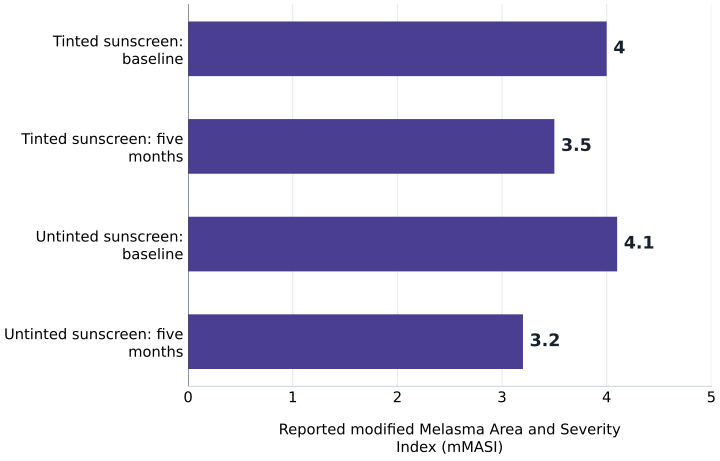
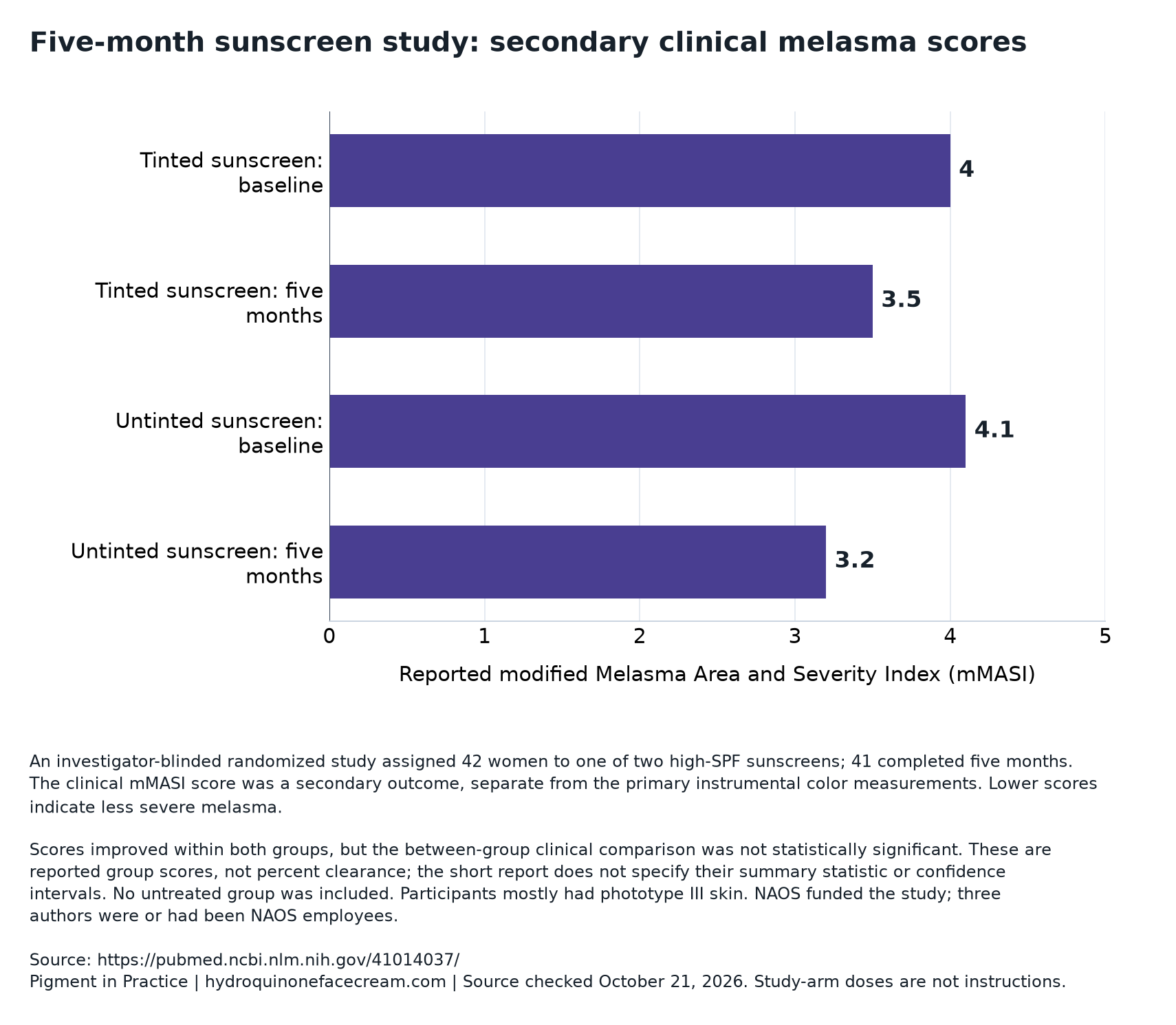
Both within-group changes had P<0.001; the between-group clinical comparison was nonsignificant. The table retains the reported score values without turning them into a rate of facial clearance. Its purpose is to make the unit and observation times explicit, so that a reader can see what the numbers actually describe.
A score and a percentage of people are different kinds of quantity. Dividing a change in score by its starting value would produce a relative change in that reported value; it would not reveal how many participants improved, cleared or considered the result worthwhile. Nor would it describe how responses were distributed. Different collections of individual outcomes can lead to the same group summary.
There is a further distinction between a measured change and its importance. To judge whether a difference matters, readers would want a justified threshold for meaningful change, the uncertainty around the comparison and information about the range of individual responses. A threshold cannot be supplied merely by calling a difference statistically significant. These additional questions make the result more interpretable without changing the unit in which it was collected.
Secondary modified Melasma Area and Severity Index (mMASI): reported group scores; summary statistic unspecified.
| Sunscreen group | Baseline score | Five-month score |
|---|---|---|
| Tinted | 4.0 | 3.5 |
| Untinted | 4.1 | 3.2 |
Different statistical questions need different comparisons
Color contrast improved significantly only within the tinted group; baseline imbalances and no untreated control limit interpretation. These features make the comparison itself central to interpretation. A test of change within one group and a test of difference between groups have different jobs.
For an illustrative statistical example, imagine two estimates that are close together, with one measured more precisely than the other. One could pass a conventional significance threshold while the other does not, even though a direct comparison would offer little evidence that they differ. It would be a mistake to subtract the two significance labels and treat the result as a treatment effect. The direct estimate and its uncertainty are what that question requires.
Starting positions also matter when interpreting movement. A group beginning farther from a reference may have a different amount of potential change, and a noisy starting measurement can influence the apparent trajectory. Random assignment improves the basis for comparison but does not guarantee identical starting measurements in a particular sample. An analysis should explain how it handles those circumstances before a visual separation on a chart is given a causal interpretation.
A severity threshold can include more than one final state
The Chinese cream trial’s primary response rule used the 0–3 Melasma Severity Scale, or MSS, at eight weeks. The US TRI-LUMA label instead describes primary success as an MSS score of zero. The companion trial analysis follows that distinction through the cream results. Neither definition can be exchanged for a sunscreen color measurement.
A worked example shows why the wording changes the interpretation. On a scale where zero represents clearance, a person moving from three to one and a person moving from two to zero have each improved by two grades. Only the second has reached zero. Counting both as responders is coherent under a change-based rule. Calling both cleared would replace that rule with a different outcome after the results were collected.
Thresholds also hide information on either side of a boundary. Two people with similar progress may fall into different categories, while people with different final states can share a response category. Continuous scores and categorical responses can therefore illuminate different aspects of the same trial. A careful account keeps each definition attached to its own denominator and time point, rather than treating a familiar word such as success as a universal clinical unit.
Adverse-event counts belong to the tested preparation
The Chinese study randomized 53 participants; 52 received treatment and entered the modified intention-to-treat analysis with last observation carried forward. Its eight-week treatment-emergent adverse-event results appear below. The active-group total comparison was nonsignificant. Zhejiang education research funding and manufacturer Zhejiang Fonow supported the study. These are cream data, not sunscreen event rates.
Counting participants with any event answers a different question from counting every event. One participant may experience several symptoms but contribute only once to an any-event total. A percentage consequently needs its numerator definition as well as its denominator. Duration of observation matters too: a proportion over one research period is not an annual risk or a probability per application.
For interpretation, separate how often an event occurred, how severe it was, whether treatment was interrupted and how confidently it was attributed to the preparation. A single combined percentage cannot communicate all four. The follow-up details guide helps organize questions about how an actual care arrangement handles uncertainty and changing symptoms. Its practical purpose is to clarify the process, not to predict that arrangement’s clinical results from a research percentage.
Participants with at least one treatment-emergent adverse event over eight weeks in the Chinese cream study.
| Study preparation | Participants with event / analyzed | Percentage of participants |
|---|---|---|
| Generic triple cream | 16 / 23 | 69.6% |
| TRI-LUMA | 19 / 21 | 90.5% |
| Placebo | 0 / 8 | 0% |
The facial site does not make safety interchangeable
Sunscreen tolerability was favorable; comparative event counts were unreported. TRI-LUMA’s label identifies hydroquinone 4%, tretinoin 0.05% and fluocinolone acetonide 0.01%; warnings include irritation, sulfite hypersensitivity, ochronosis and systemic corticosteroid effects. It also identifies pregnancy concerns and cautions about contact with eyes, the nose and mouth. These facts belong to their respective preparations and evidence settings.
A useful safety explanation identifies the kind of problem being discussed. Local discomfort, an allergic reaction, a pigmentary change and a systemic effect are not interchangeable outcomes merely because each might appear under a safety heading. Combining them into a single reassuring adjective removes information a clinician needs. Conversely, a warning about a possible event does not supply its frequency in every population or every formula.
The FDA reports rashes, facial swelling and potentially permanent ochronosis with hydroquinone skin-lightening products, and states that OTC hydroquinone products are not approved for safety or effectiveness. Those reports do not provide a comparative incidence estimate. When consulting the Dermatica preparation review, use it to locate documentary questions about the proposed product and follow-up. A provider name does not connect a particular offer to the trial preparation or transfer its benefit and harm findings.
Clinical appearance and personal burden deserve separate study
A study designed around a severity scale can be informative without answering every question a person has about their face. An original research extension would ask participants which changes matter to them, define those outcomes in advance and assess them alongside clinical observations. Agreement between the measures would be informative; disagreement could also reveal something useful about what each captures.
For example, a hypothetical participant might value predictability more than the largest change at a single visit, while another might prioritize whether a conspicuous area remains noticeable. These are illustrations of possible preferences, not findings from the sunscreen trial. Converting either preference into a research outcome would require a clear question, a consistent way to record the answer and an analysis that respects how the information was collected.
Clinical discussions likewise benefit from separating the desired outcome from the proposed route to care. The Musely preparation review can be used to check the public documentation and identify questions still requiring an answer. That is an editorial use of a review, rather than evidence that a service delivers a particular severity change. A precise goal and an identifiable preparation make the conversation more concrete without replacing professional assessment.
Better facial studies would connect the measurements explicitly
NAOS Ecobiology Company funded this study; three authors were current or former employees, and investigator honoraria were disclosed. Disclosure helps readers consider who participated in producing the evidence. It is not an alternative to examining the comparison, the measurements and the analysis. Those features remain assessable whether a reader is optimistic or skeptical about the sponsor.
A useful next investigation would prespecify how local color findings relate to clinical severity and participant-reported experience. It could show individual trajectories without exposing identities, report uncertainty for the main comparison and explain missing observations. If differences between facial areas are of interest, the study would need to plan that question rather than select the most persuasive area after seeing the results.
The strongest connection to practice would come from testing the exact question that currently requires an assumption. That could mean an additional population, a different preparation or a longer observation period, but each would need an appropriate design. Adding participants alone would not fix an ambiguous endpoint. The comparison of face-cream routes applies the same editorial discipline to public records: establish what is actually being compared before assigning meaning to a difference.
Questions about the evidence
Does a color reading show whether a facial mark is melasma?
A treatment-study measurement does not independently establish the diagnosis for a new reader. Its role is to quantify an observation within the research question. Applying that observation elsewhere first requires a reason to consider the conditions comparable. Similar appearance is a starting question for assessment, not the missing evidence itself.
Can a lower group score tell me my chance of improvement?
No individual probability follows from a group score alone. It does not reveal how many participants improved, the spread of their responses or which starting characteristics mattered. Turning a score into a personal prediction would require additional data and a prediction method that had been evaluated for that purpose.
Why include cream safety data in a sunscreen discussion?
The comparison shows how the question changes when the preparation changes. It is useful for understanding event definitions and the information needed to evaluate a facial treatment. It is not a way to assign the cream’s adverse-event percentage to sunscreen or compare the two as competing treatments in one trial.
Would a larger sample automatically settle the clinical comparison?
More observations can improve precision, but they do not repair a poorly defined question or guarantee a meaningful difference. Researchers still need an appropriate comparator, reliable measurements and an analysis suited to the outcome. Establishing equivalence would additionally require a justified acceptable margin and evidence sufficiently precise to evaluate it.
What should a review help me document before a clinical discussion?
Useful details include the exact proposed preparation, the condition being considered, the intended outcome and the arrangements for reassessment. Our editorial interpretation is that these details make unanswered questions visible. They do not let a review choose a personal regimen or certify a provider’s results using someone else’s study.
What this evidence supports
The most defensible reading begins with a specific facial assessment and keeps the observations in their original units. Local color, a clinician’s severity assessment and a participant’s experience can contribute to understanding without becoming substitutes for one another. Benefit and harm also need to remain attached to the preparation actually evaluated. This leaves a practical research question: how well do these different observations agree, for which people, and over what period? A useful answer would connect them explicitly rather than imply that a favorable value in one domain settles all the others. For an individual, that evidence supports a more precise clinical conversation; it does not supply a treatment decision.
Research access and limitations
This analysis uses the full sunscreen research letter, full Chinese cream report, official TRI-LUMA prescribing information and the FDA consumer notice. The sunscreen supplement and figure-derived numbers were not reviewed; clinical-score confidence intervals were unreported. The article offers methodological interpretation, not patient-level predictions or an assessment of any provider’s clinical outcomes.
Keep the documents in view
- Comparison of Visible Light-Protective Tinted Sunscreen to Untinted Sunscreen to Protect Melasma Patients During Summer: A Prospective Randomized Investigator-Blinded Study. ↗Full primary research letter plus verified PMC funding footnote; supporting-information document and figure-derived numerical data not reviewed · Accessed 2026-10-21
- DailyMed: TRI-LUMA prescribing information ↗Full official prescribing information · Accessed 2026-10-21
- Efficacy and Safety of Generic Fluocinolone Acetonide, Hydroquinone, and Tretinoin Cream Compared With TRI-LUMA for the Treatment of Moderate-To-Severe Melasma in Chinese Patients: A Randomized, Single-Center, Placebo-Controlled Trial. ↗Full research article, with indexed abstract where available · Accessed 2026-10-21
- FDA warns consumers of skin products containing mercury and/or hydroquinone ↗Current FDA consumer safety notice, introductory safety text read; individual product-testing table is not used for provider comparisons. · Accessed 2026-10-21